
The Five Threads of Period of Change
A Framework for Shame-Free Puberty Education
Puberty education for girls and menstruators in the US is far from comprehensive and inclusive, and in no way empowering. Even now (in the twenty-first century!) the tone is clinical at best and generally colored with shame-based purity culture overtones. The underlying message, whether spoken or implied, is that their changing bodies are problems to manage.
Girls are warned about pregnancy and disease, but rarely invited into an actual positive relationship with their own cyclical bodies. Anatomy may be referenced, often with giggles or cringes, and euphemisms are still used far more often with our youth than accurate medical terminology. Pleasure as a concept is side-stepped completely – especially with females – and consent may be mentioned but is rarely given the full depth and context that it deserves.
Period of Change was born in response to this lack of robust information and the deep knowledge of our bodies and cycles that is our birthright.
Evolving organically through over fifteen years of sitting in circles with girls and their mothers – listening to their questions, their grief, their embarrassment, and their brilliance – I have shaped Period of Change as not just another health or sex ed class, but rather as an integrated framework. Our culture lacks a perspective on girls and women that is spacious enough to hold science, sovereignty, pleasure, lineage, and cultural critique all at once. My work with Period of Change has evolved to become a beautiful tapestry of five interwoven threads spun from the medical and the magical, the sacred and the scientific that now shape every circle, training, and resource I create.
Thread 1: Shame-Free Body Sovereignty
At the heart of Period of Change is a simple but radical belief: a girl’s body belongs to her.
That statement may seem obvious, but our culture does not consistently reinforce it. From a young age, girls receive subtle and overt messages that their bodies are for evaluation, regulation, consumption, or control. Shame-free body sovereignty interrupts that pattern by teaching girls that their bodies are not public property, not future obligations, and not problems to solve, but wise systems worthy of respect and authority.
This begins with language: we use accurate anatomical terms without whispering or giggling. We name the vulva, the vagina, the uterus, the cervix, and the clitoris with steadiness and clarity, because when girls are given the correct words for their bodies, they are given a foundation of power and self-respect. A body that can be named can be understood. A body that can be understood can be cared for without shame.
But body sovereignty is not only about vocabulary, it is about restoring trust in the body’s cues. Hunger, fatigue, tears, irritation, desire, and even discomfort are not character flaws; they are communication. When a girl learns that her internal experience is valid data rather than evidence that she is “too much,” – or cursed! – she begins to inhabit herself differently. She learns that she can ask for rest, advocate for a bathroom break, decline touch, or express enthusiasm without apology. Sovereignty becomes a lived practice rather than a pop-culture catch phrase.
Thread 2: The Pre-Menstrual Signals Paradigm
Closely woven with body sovereignty is what I call the Pre-Menstrual Signals paradigm, which reframes many of the experiences we have been taught to dismiss as dysfunction and reclaims this information as wise and worthy of our attention.
For decades, premenstrual shifts have been reduced to a punchline or pathologized as “PMS,” a term that has often been used to trivialize women’s and menstruators’ emotional lives. In Period of Change, we teach girls that these shifts are not disorders to be mocked or suppressed, but signals to be interpreted. Pre-Menstrual Signals might indicate a need for more rest and solitude, clearer boundaries, honest conversations, or simply nourishment.
From early childhood, we teach children that hunger and fatigue are legitimate signals. If a child is hungry, we feed them. If they are tired, we encourage sleep. We do not shame them for these needs, and we encourage them to understand and to respond to these signals as they grow. Yet when hormonal signals arise in adolescence, menstruators are often told to disconnect from their embodied lived experience; to push through, quiet down, or stop being dramatic.
The Pre-Menstrual Signals Paradigm restores continuity by affirming that cyclical changes are part of the same intelligent communication system that governs hunger and sleep. We don’t call hunger “pre-eating syndrome,” and we don’t call fatigue “pre-sleeping syndrome,” because we recognize that the physical and emotional shifts related to sleep and hunger are due to our body’s need for an attentive and caring response.
Instead of suppressing or overriding every uncomfortable feeling or medicating away every shift, we cultivate curiosity. What is my body asking for right now? What would it mean to respond with care rather than resistance? When girls learn to approach their cycles with curiosity instead of contempt, their relationship with their bodies softens, and a lifelong practice of self-awareness – and true self-care – begins.
Thread 3: Cycle Literacy Through the Seasons
Another essential thread of this framework is cycle literacy, which invites girls to understand the menstrual cycle as an ongoing rhythm rather than a monthly inconvenience.
We map the cycle onto the seasons as a way of making its shifts intuitive and embodied. The menstrual phase becomes an Inner Winter, a time when energy may naturally draw inward and rest becomes essential. The follicular phase mirrors Inner Spring, when ideas, curiosity, and forward momentum begin to re-emerge. Ovulation reflects Inner Summer, often accompanied by outward energy and desire for connection. The luteal phase corresponds to Inner Autumn, when discernment sharpens and unfinished business asks to be tended.
This seasonal lens offers girls a compassionate and relatable framework for their fluctuating energy. Instead of expecting themselves to feel identical every day of the month, they begin to anticipate variation as part of their design. They learn that there will be days that invite solitude and days that invite sociability, days of creativity and days of completion. None of these states are evidence of instability; they are evidence of rhythm. We don’t expect the flowers of summer to grow and bloom all year round, and we need not expect the same constant level of energy and output throughout the phases of our cycle.
Cyclical literacy and also has practical implications. When girls learn to use cycle tracking to plan with their bodies rather than against them, they experience less self-judgment. They begin to recognize patterns in their focus, mood, and motivation, and that recognition can be profoundly stabilizing. Rather than internalizing the message that they are inconsistent, moody, or flawed, they come to understand themselves as cyclical beings moving through predictable, meaningful phases.
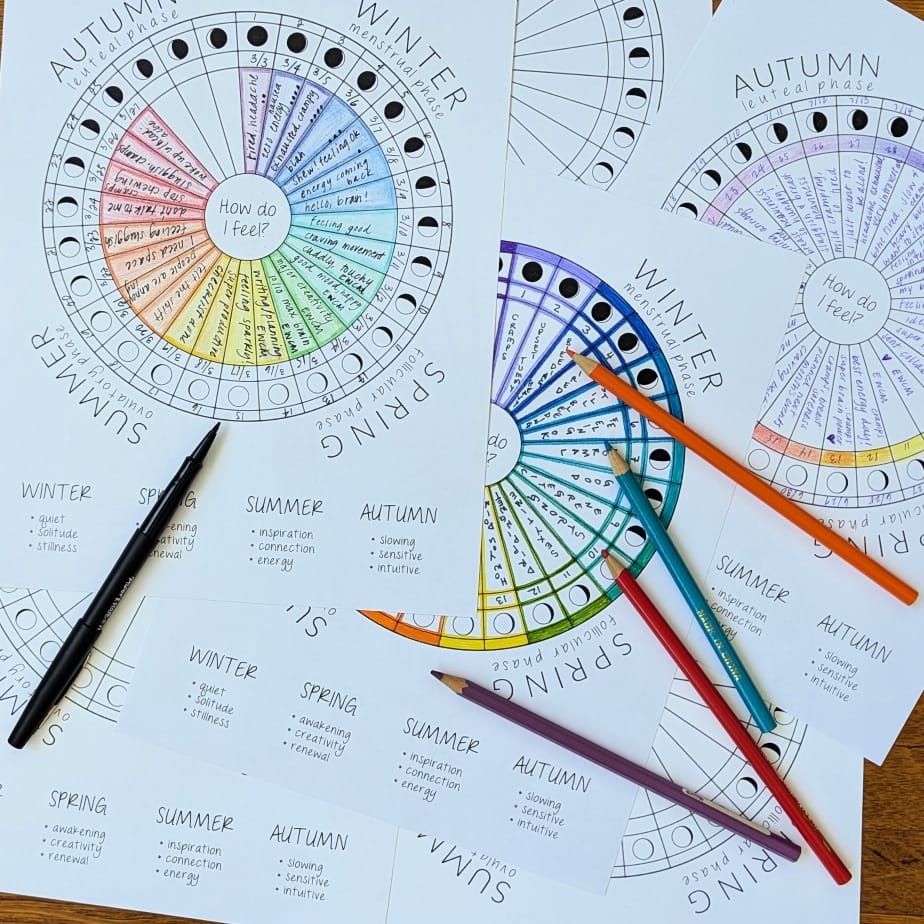
Cycle literacy begins with understanding the rhythm of the menstrual cycle — not just bleeding, but the four distinct phases that shape energy, emotions, and needs.
This cycle tracking wheel is a simple visual tool to support that learning and to help young menstruators build trust in their bodies from the very beginning.
The Four Seasons Cycle Tracker is the tool I wish I’d had when I was younger! I am so happy to share it with families who want to raise body-literate, confident girls. (And yes, it's great for moms & caregivers to use too!)
Thread 4: Pleasure as Sacred Physiology
Perhaps one of the most misunderstood (and consequently avoided) elements of this work is the thread of pleasure.
In a culture that often approaches puberty education through fear and risk management, pleasure is either ignored or treated as dangerous and shameful. Yet the female body (and only the female body) contains an organ, the clitoris, whose sole physiological purpose is pleasure. That fact alone disrupts the narrative that women’s bodies exist only for reproduction or service. Pleasure is not secondary or accidental; it is and anatomical priority.
When we speak about pleasure in Period of Change, we do so in grounded, age-appropriate ways that connect sensation, self-awareness, and consent. We introduce the concept of the pleasure map of the five senses, encouraging girls recognize that enjoyment can be found in taste, touch, sound, sight, and scent long before it is associated with sexuality. We normalize curiosity about anatomy and self-pleasure, and teach that bodily autonomy and consent are inseparable.
When a girl understands that her body is designed for pleasure, and that pleasure is not shameful, her internal landscape shifts. She is less likely to tolerate discomfort in relationships. She is more attuned to what feels safe and what does not. She begins to understand that her body is not merely a site of risk but a source of sensation, creativity, and joy.
Thread 5: Creating a Period-Positive Culture
The final thread restores something our culture has largely abandoned and, in many cases, actively undermined: the intentional cultivation of a period positive culture within the home and community.
Menarche, a girl’s first period, is a biological event, but it is also a threshold. How that threshold is marked leaves an imprint that can last for decades. When a first bleed is met with silence, embarrassment, irritation, or inconvenience, the message is quietly absorbed: something about this is wrong, burdensome, or shameful. When it is met with preparation, celebration, honesty, and respect, however, a different message takes root: my body is doing exactly what it was designed to do, and I am worthy of care as I grow.
In Period of Change, I encourage families to mark this transition intentionally, whether through a simple mother-daughter ritual, a gathering of trusted women, a written blessing, or a thoughtfully prepared first period basket. The form can vary widely depending on culture, comfort, and context, but the principle remains the same: this moment matters, and it deserves to be held and witnessed with dignity.
Creating a period positive culture extends beyond a single day. It means using accurate language without euphemism or shame. It means keeping menstrual care supplies visible and accessible rather than hidden. It means refusing jokes or dismissive comments that demean menstruation, and ensuring that boys and men understand the cycle as a normal and meaningful aspect of human life.
But this thread is not only for daughters. When mothers participate in creating a period positive culture, their own cultural conditioning will often rise to the surface for processing and healing. Many women were taught to hide, minimize, or endure their cycles in silence. By choosing to do this differently for their daughters, mothers are given an opportunity to heal their own inherited wounds around puberty and menstruation. In doing so, they do more than support their child; they shift the mother-daughter legacy itself.
Creating a period positive culture is an act of cultural repair. It is a conscious decision to say, in word and action, that menstruation is not a problem to manage but a rhythm to understand and honor, and that every girl deserves to enter this phase of life feeling prepared, respected, and supported.
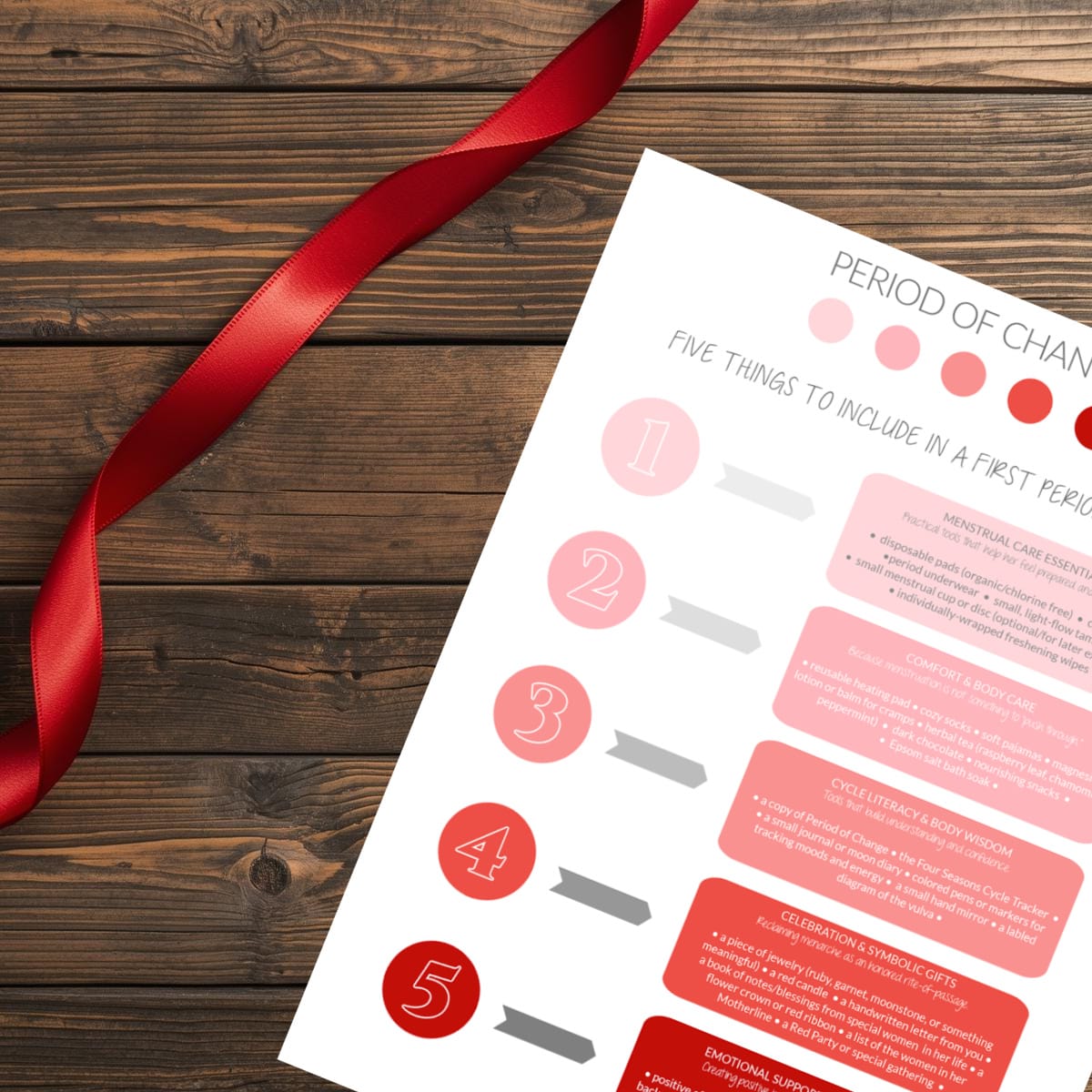
Not sure what to include?
Creating a first period basket doesn’t have to be complicated.
This free download gives you five essential categories — with thoughtful examples in each — so you can build a basket that supports her physical needs, emotional well-being, and body literacy.
Instead of scrambling at the last minute, you’ll feel steady, prepared, and intentional. Start here, and give her a first experience rooted in dignity and care.
Weaving it All Together
When these five threads are woven together – shame-free body sovereignty, the Pre-Menstrual Signals paradigm, cyclical literacy, pleasure as physiology, and creating a period-positive culture – we create something far more cohesive than a standard puberty talk. We create an orientation to the body that is rooted in respect and agency.
This is what girls were always meant to inherit: not just a diagram of reproductive organs, but a framework that tells them their bodies are wise, their rhythms are meaningful, and their voices carry authority. When we teach from this place, we are not simply offering education; we are reshaping the story a girl carries in her body about what it means to grow into womanhood.
For more guidance on navigating this transition — from early cycle irregularity to body literacy, from practical support to meaningful celebration — I walk through each step in Period of Change: Welcoming Your Daughter’s Period with Care and Confidence.
It was written for this exact moment: when a mother wants to respond with steadiness, clarity, and intention, even if she did not receive that herself.
If you are a mother who wants to offer your daughter something different than what you received — something rooted in knowledge, dignity, and celebration rather than confusion or silence — I invite you to explore the Period of Change circles and resources created for girls and their families.
If you are an educator, therapist, or women’s circle leader who feels the cultural shift that is needed and wants to carry this framework into your own community, Period of Change Leadership Training is designed to support you in doing this work with integrity and depth.
If this framework resonates with you, I would love for you to share this post with a mother, daughter, or educator who is ready for a different way of approaching puberty and the menstrual cycle.

Empowering girls* with body
sovereignty and cycle literacy,
one circle at a time.


Be the first to know about upcoming circles, retreats, and offerings—plus receive heartfelt wisdom and resources to support your journey.
amy@periodofchange.com
All content, images, and event names © Amy Wilding 2025
Photo credit: Amy Wilding | Kitra Cahana | Sarah Hester
KGWildways font (based on Amy Wilding's handwriting) © Kimberly Geswein
T&C
* All Period of Change events are inclusive, and welcome menstruators and future-menstruators of all gender identities and expressions.
Empowering girls* with body sovereignty
and cycle literacy, one circle at a time.
* All Period of Change events are inclusive, and welcome menstruators and future-menstruators of all gender identities and expressions.
Be the first to know about upcoming circles, retreats, and offerings—plus receive heartfelt wisdom and resources to support your journey.
All content, images, and event names © Amy Wilding 2025
Photo credit: Amy Wilding | Kitra Cahana | Sarah Hester
KGWildways font (based on Amy Wilding's handwriting)
© Kimberly Geswein
T&C