
My Daughter Started Her Period - What Do I Do?
Don't panic! We got this.
Here it is: the moment you’ve known was coming. You may have marked it quietly in your mind years ago, when you first held her as a baby, or when you bought her first bra, or when her body began to lengthen into adolescence. And now that it has arrived, you may notice that preparation and feeling ready are not always the same thing.
Now that this milestone has arrived, you may be experience a flurry of thoughts and feelings. You might feel a flicker of dread, imagining discomfort, awkward school days, or the cultural messages she will inevitably absorb about menstruation. You may feel grief as you sense her stepping out of the “little girl” chapter and into a stage that feels both powerful and newly vulnerable. You may feel a surprising surge of excitement as she crosses into young womanhood, into a lineage of cyclical wisdom that connects her to you and to generations before you. You may feel a fierce desire to offer her the guidance and initiation you did not receive.
All of that can coexist.
How to Support Your Daughter Emotionally
As moms, we tend to prioritize our children's well-being above our own, but in this moment, I invite you to connect with yourself, when you were her age. Imagine yourself as the girl you were when your own period first began. What did she need? What did she wish someone had explained clearly? When we pause long enough to remember her, we often find the most clarity in how to best support our daughter.
Your daughter may also be carrying complex and conflicting emotions. She may feel proud and embarrassed in the same breath. She may feel grown up and suddenly unsure. She may shrug and move on, or she may want to talk for an hour. Genuinely supporting her means welcoming every feeling she brings without layering your own narrative on top of hers. When she senses that her internal experience is safe in your presence, she learns to trust herself.
Practical support matters deeply in this season. Providing accurate information about what menstruation is and how the cycle works gives her language for her body. Empowering her with self-advocacy tools—how to ask for a bathroom break, how to request pain relief, how to speak up if something feels off—builds confidence that extends far beyond her cycle.
What Should I Say When My Daughter Gets Her First Period?
Answering her questions without embarrassment, and using correct anatomical terms with ease, communicates that her body is worthy of care and clarity rather than secrecy. Offering a range of menstrual care supplies—pads, tampons, period underwear, and eventually cups if she is curious—allows her to discover what feels most comfortable now and as she grows. When you hand her these items calmly and matter-of-factly, you are also handing her a message: your body is capable, intelligent, and nothing about it needs to be hidden.
Alongside the practical, this is also a moment for affirmation. You might tell her:
“This is such a special moment.”
“Your body is doing something powerful.”
“This is part of becoming a young woman, and it’s a beautiful shift.”
“I love that you came to me.”
“Your cycle is a sign that your body is healthy and working exactly as it should.”
Even a simple smile and a hug can communicate what words sometimes cannot.
Even with affirmation and positive intentions, she may not want to talk much at first–and that's okay. Some girls need time to metabolize new information. You can gently open the door with invitations rather than interrogations:
“How are you feeling about everything today?”
"I am happy to answer any questions you have. There's nothing to feel embarrassed about, and all topics are on the table."
“Would you like me to explain a little more about how the cycle works, or would you rather wait?”
“Is there anything I can do to help you feel more prepared or supported?”
Some families find it helpful to keep a question and comments jar in a shared space, where she can drop notes when she thinks of something she wants to ask, while others share a mother-daughter journal that travels back and forth on a nightstand. These small invitations to connect can create surprising ease.
Teaching Girls to Track Their Cycle
One of the most powerful tools you can offer her (and yourself!) is the practice of cycle tracking. When she begins to notice patterns—energy rising and falling, sociability shifting, appetite changing—she starts to see her body as rhythmic rather than unpredictable.
We can normalize these shifts by comparing them to the seasons of the year, where winter invites rest, spring brings momentum, summer offers outward expression, and autumn calls for reflection. In this framework, Pre-Menstrual Signals become meaningful messages rather than a pathology to endure. You can explore this together through a simple four seasons cycle tracker that helps her connect biology to lived experience.
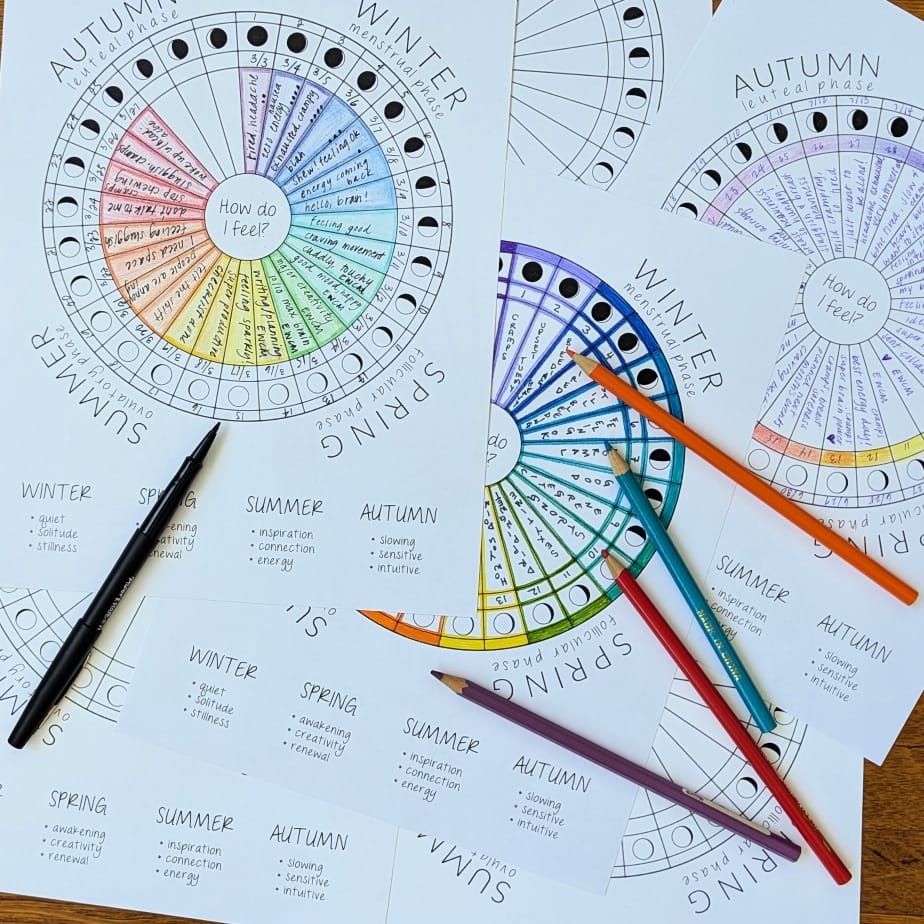
Cycle literacy begins with understanding the rhythm of the menstrual cycle — not just bleeding, but the four distinct phases that shape energy, emotions, and needs.
This cycle tracking wheel is a simple visual tool to support that learning and to help young menstruators build trust in their bodies from the very beginning.
The Four Seasons Cycle Tracker is the tool I wish I’d had when I was younger! I am so happy to share it with families who want to raise body-literate, confident girls. (And yes, it's great for moms & caregivers to use too!)
How to Support Your Daughter During Her First
Year of Menstruation
It also helps to prepare her for what the first year or two may hold. Early cycles are often irregular as the communication between brain and ovaries stabilizes. She may skip months, bleed lightly one cycle and more heavily the next, or experience cramping, headaches, fatigue, or mood fluctuations as her hormones find their rhythm. Over time, cycles typically become more consistent. If she is soaking through a pad every hour for several hours, bleeding longer than ten days, experiencing pain that keeps her from daily life, going more than three months without a period after they have begun, or feeling dizzy and faint, it makes sense to consult a healthcare provider who can assess her individual situation with care.
How to Create a First Period Basket
Marking this transition can also feel meaningful, depending on her personality. Some girls prefer a quiet acknowledgment and a special outing with you. Some love the idea of a small gathering with trusted women. Some want a piece of jewelry, a handwritten letter, or a “Moon Basket” filled with comfort items. The most important question is simply, “How would you like to mark this?” Allow her preference to lead.
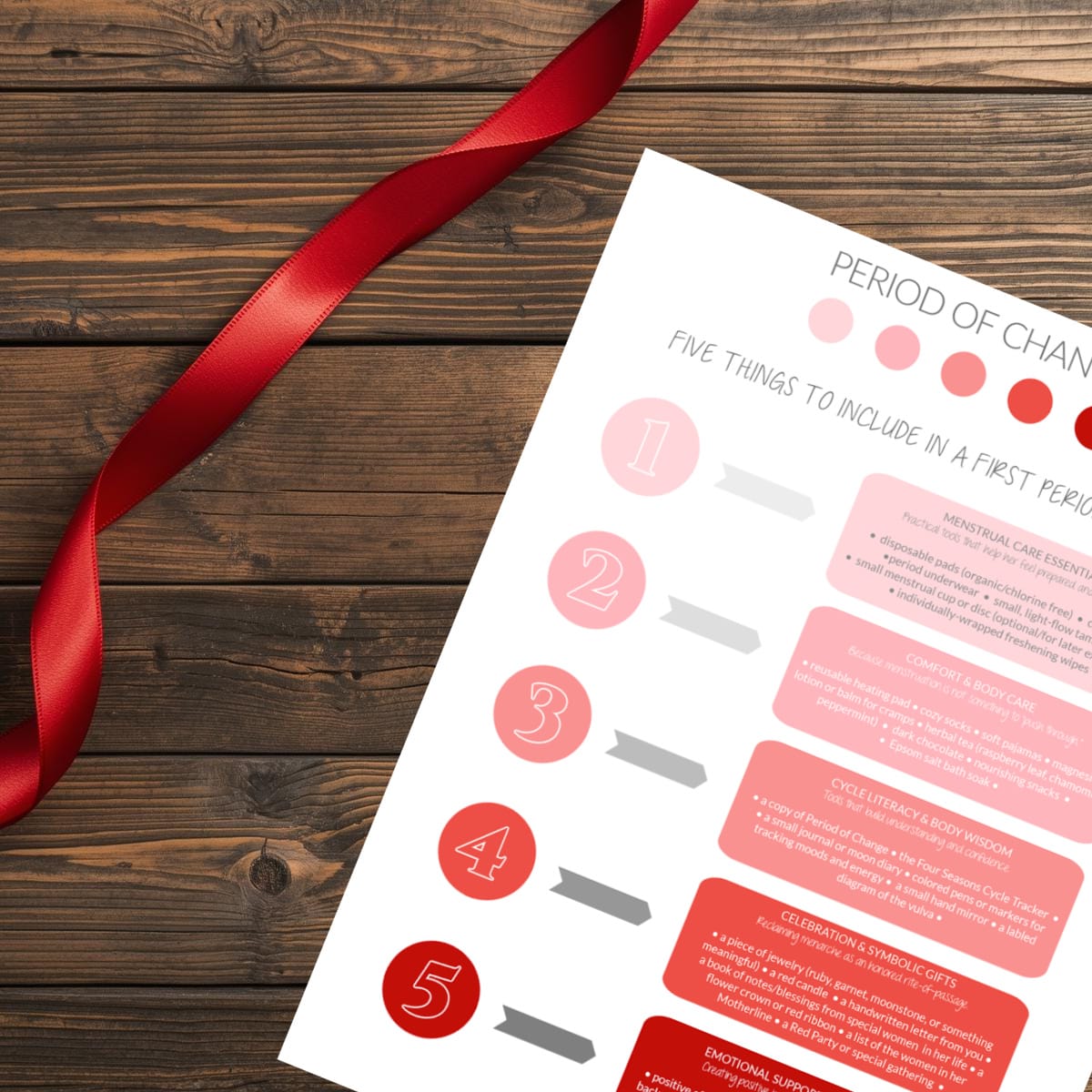
Not sure what to include?
Creating a first period basket doesn’t have to be complicated.
This free download gives you five essential categories — with thoughtful examples in each — so you can build a basket that supports her physical needs, emotional well-being, and body literacy.
Instead of scrambling at the last minute, you’ll feel steady, prepared, and intentional. Start here, and give her a first experience rooted in dignity and care.
Meeting This Milestone with Confidence and Connection
Above all, your comfort becomes the foundation for hers. When you speak about menstruation with ease, when you handle supplies matter-of-factly, when you treat her cyclical shifts as intelligent rather than inconvenient, she absorbs that confidence. Your calm presence becomes the rooted foundation that allows her to move through this period of change with self-assurance and connection, knowing that her body is wise and that you are walking right along side her.
For more guidance on navigating this transition — from early cycle irregularity to body literacy, from practical support to meaningful celebration — I walk through each step in Period of Change: Welcoming Your Daughter’s Period with Care and Confidence.
It was written for this exact moment: when a mother wants to respond with steadiness, clarity, and intention, even if she did not receive that herself.
If you are a mother who wants to offer your daughter something different than what you received — something rooted in knowledge, dignity, and celebration rather than confusion or silence — I invite you to explore the Period of Change circles and resources created for girls and their families.
If you are an educator, therapist, or women’s circle leader who feels the cultural shift that is needed and wants to carry this framework into your own community, Period of Change Leadership Training is designed to support you in doing this work with integrity and depth.
If this idea resonates with you, I would love for you to share this post with a mother, daughter, or educator who is ready for a different way of approaching puberty and the menstrual cycle.

Empowering girls* with body
sovereignty and cycle literacy,
one circle at a time.


Be the first to know about upcoming circles, retreats, and offerings—plus receive heartfelt wisdom and resources to support your journey.
amy@periodofchange.com
All content, images, and event names © Amy Wilding 2025
Photo credit: Amy Wilding | Kitra Cahana | Sarah Hester
KGWildways font (based on Amy Wilding's handwriting) © Kimberly Geswein
T&C
* All Period of Change events are inclusive, and welcome menstruators and future-menstruators of all gender identities and expressions.
Empowering girls* with body sovereignty
and cycle literacy, one circle at a time.
* All Period of Change events are inclusive, and welcome menstruators and future-menstruators of all gender identities and expressions.
Be the first to know about upcoming circles, retreats, and offerings—plus receive heartfelt wisdom and resources to support your journey.
All content, images, and event names © Amy Wilding 2025
Photo credit: Amy Wilding | Kitra Cahana | Sarah Hester
KGWildways font (based on Amy Wilding's handwriting)
© Kimberly Geswein
T&C